
Shilajit explained
Shilajit Honey Sticks: How Much Shilajit Is Really in One?
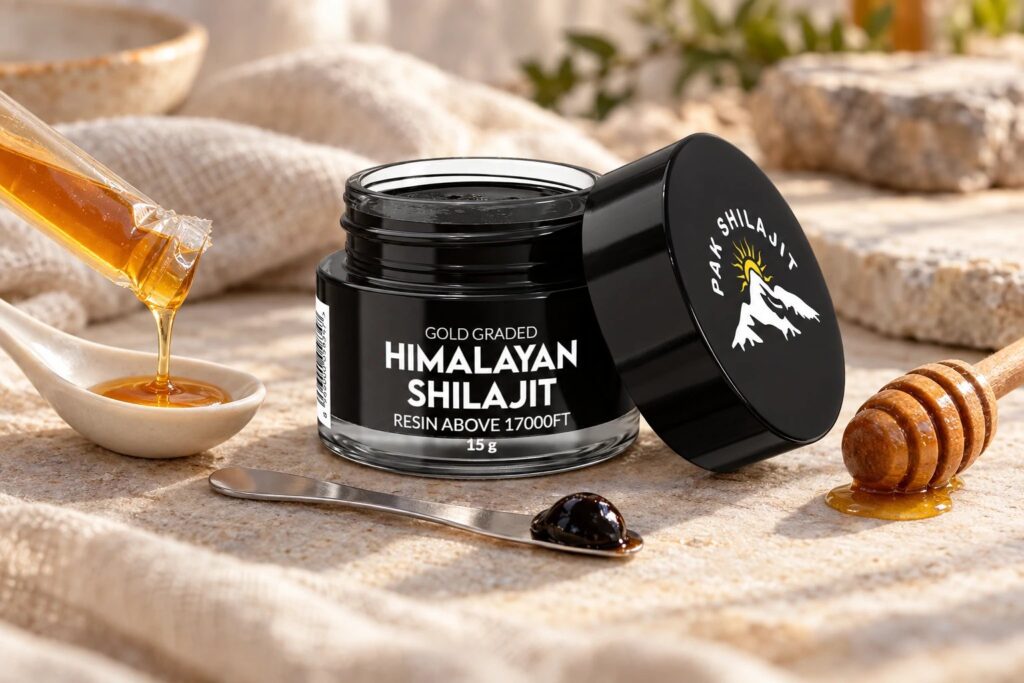
Search Amazon for shilajit honey sticks and you get sixteen listings on the first page, six of them ads, and almost every one printing the same two numbers: 75% fulvic acid, 85 trace minerals. What none of them prints in a place you can find it is the one number that matters. How much shilajit is actually in the stick?
Here is the short answer, with the sources attached. A shilajit honey stick is 250 to 500 mg of shilajit stirred into a few grams of honey, on the labels that say. That is a normal daily serving of shilajit, the same range the human trials used, with one to two teaspoons of sugar riding along. Whether it is worth buying comes down to what you are paying for: the shilajit, or the sachet.
The rest of this page does the sums. What is in one, brand by brand. How much sugar. Whether the honey earns its place. What the claims rest on. And what a stick costs against a jar of the same thing.
What is actually in a shilajit honey stick?
Two things, mostly: honey and shilajit resin. Some add saffron for the colour and the name, some add a handful of herbs for the “for women” or “pro energy” line. The shilajit amount is the part that varies, and the part several brands leave off the page you are looking at.
Here is what the listings say, read on 23 and 24 September 2026. Where a listing does not state the amount, the table says so, because that is a finding in itself.
| Product, as listed | Shilajit per stick | What else is in it | Sticks per pack | Price seen | Per stick |
|---|---|---|---|---|---|
| Better Alt Himalayan Shilajit Honey Sticks | 400 mg (stated on the Target listing, not in the Amazon bullets) | honey, saffron | 30 on Amazon, 21 at Target | $29.99 Amazon, $21.99 Target | $1.00 to $1.05 |
| Better Alt She-Lajit Pro Energy | 250 mg, plus ashwagandha, ginkgo, maca and chasteberry | honey | not shown | $28.99 Amazon | not calculable |
| Natruveda Shilajit Honey Sticks for Women | 300 mg, plus six herbs | honey | 12 | $9.99 on the brand site | $0.83 |
| Natural Shilajit NutriHoney | 500 mg | 4.5 g raw honey | 30 | $59 on the brand site | $1.97 |
| Trace Minerals Shilajit Honey Sticks | not stated on the product page | honey, ionic trace minerals | not shown | $37.99 on the brand site | not calculable |
| Bargad, Anecdote, Bloomin (Amazon) | not stated in the listings | honey, some with saffron or shatavari | 30 | $16.99 to $29.99 | about $1.00 |
Three things jump out. The stated doses run from 250 to 500 mg, which is a real serving, not a trace. The biggest seller states its dose on one retailer’s page and not on its own Amazon bullets, so most buyers never see it. And a third of the shelf states nothing at all.
“Himalayan” on the front tells you less than you would think. Most listings do not say which country the resin came from, and one of the best-known sticks uses resin from the Altai mountains, which are in Siberia, not the Himalayas. That is not a fault. It is just a reminder that the word is decoration unless the brand names the source.
How much shilajit is in one stick, and is that a real dose?
Enough to count. The human trials of shilajit used 200 to 500 mg a day of a standardised extract, and one went to 1,000 mg for eight weeks. Our dosage guide lists every one of them with the dose, the length and who took it. A stick at 300, 400 or 500 mg sits squarely inside that window. Whoever told you honey sticks are “mostly honey with a pinch of shilajit” had not read the labels. We had not either, until we did this. Our own dosage guide said as much, and it has been corrected.
Two caveats, because they change the picture.
Milligrams of what. The trials used a standardised extract in capsules. A stick uses resin, or says it does. Extract milligrams and resin milligrams are not the same thing and there is no conversion factor between them; the dosage guide explains why. So “400 mg” on a stick is a real number for the resin that went in, not a promise that it matches a trial.
A fixed dose you cannot halve. A stick is one dose, sealed. Natruveda’s box says one to two sticks a day. Two of theirs is 600 mg; two of Better Alt’s is 800 mg. That is above every trial in the table except the two that went to 1,000 mg and 2 g. There is no reason to take two, and no easy way to take half.
How much sugar is in a shilajit honey stick?
Honey is sugar with a story. The USDA’s reference record for honey puts it at 82 g of sugar per 100 g, most of it fructose and glucose, and 304 calories (USDA FoodData Central, record 169640). A stick is honey plus a pea of resin, so the honey weight is the sugar weight, near enough.
The one brand that prints its honey weight, Natural Shilajit, puts 4.5 g in each stick. That is 3.7 g of sugar and 14 calories. A level teaspoon of table sugar is about 4 g, so one of those sticks is a teaspoon. The larger sachets weigh up to about 10 g including the film, so a big stick can be close to 8 g of sugar, or two teaspoons. Nobody in the top twenty results does this arithmetic, so here it is.
Is that a lot? On its own, no. Against the day’s budget, it is a slice. The FDA’s Daily Value for added sugars is 50 g a day on a 2,000-calorie diet, and the Dietary Guidelines say to keep added sugars under 10% of calories (FDA). The same FDA page counts “sugars from syrups and honey” as added sugars. One stick is 7 to 16% of that budget. Fine for most people. Worth knowing if you are counting carbohydrates, managing blood sugar, or buying them for a teenager who will eat three.
One label claim to read carefully: “no added sugar, just honey and herbs”. On a honey product, the honey is the sugar. The sentence is true and empty at the same time.
And one hard line that has nothing to do with shilajit. Honey is not safe for babies. The CDC’s instruction is plain: do not feed honey to a child younger than one year, because it can carry the bacteria that cause infant botulism (CDC). Nobody should be giving shilajit to an infant anyway, but a sweet golden stick on a kitchen counter is the kind of thing that gets shared.
Does the honey do anything, or is it just the spoon?
It is the spoon. A good spoon, but the spoon.
We searched PubMed for any human study of shilajit taken in honey. There is one hit, a 2016 paper on a wound-dressing gel, which is not a supplement study and not about you (PubMed). Every trial behind every “benefits” bullet on a stick listing used extract in a capsule or tablet, without honey. The combination has never been tested in people. That does not make it bad. It means the honey brings no evidence of its own to the stick.
Honey does have its own research, and the dose is the tell. The main review of honey and health, from the Swiss Bee Research Centre, concludes that honey shows positive effects “if consumed at higher doses of 50 to 80 g per intake” (Bogdanov 2008). A stick carries 4.5 to about 10 g. At that amount the honey is doing two honest jobs: making a bitter, tarry resin taste like caramel, and making it pourable so a machine can seal it into a sachet. That is real convenience. It is not a second active ingredient.
Ayurveda has a word for this, anupana, the carrier you take a remedy with, and honey is the traditional carrier for shilajit. That is a tradition, and we say so. It is not a finding.
Shilajit honey sticks benefits: what the trials measured
Whatever a stick can do, the shilajit is doing, and the evidence for shilajit is the same nine human trials whichever form it comes in. None of them used a honey stick. Here is what they measured, stated as measurements, not promises.
- Fatigue and strength. Keller 2019 gave 63 active men 250 or 500 mg a day for eight weeks and measured how much strength they kept after a fatiguing exercise test (PubMed).
- Testosterone. Pandit 2016 gave healthy men aged 45 to 55 a purified extract at 250 mg twice a day for 90 days and measured total and free testosterone (PubMed).
- Bone. Pingali 2022 gave 60 postmenopausal women with low bone density 250 or 500 mg a day for 48 weeks and measured bone mineral density (PubMed).
- Collagen. Neltner 2024 gave 35 trained men 500 or 1,000 mg a day for eight weeks and measured a marker of collagen synthesis (PubMed).
- Fertility. Biswas 2010 gave men with low sperm counts 100 mg twice a day for 90 days, in a clinic, and measured sperm count, motility and testosterone (PubMed).
Notice the doses. Every one of those studies sits at or around what a single stick contains. That is the fair case for sticks: the amount is not the problem.
Now the questions Google shows under every stick search. “What does shilajit do for a man” is answered by the Pandit and Keller trials above and by nothing else. “Is shilajit a natural Viagra”: no trial has measured erections, so there is nothing to report. “Can shilajit increase size”: no trial has measured it, and no honest page will tell you otherwise. Our side effects guide covers the women’s trials and the one pregnancy case report, if that is the question you came with.
Side effects of shilajit honey sticks
A honey stick carries the side effects of shilajit plus the honey, plus whatever herbs the brand added.
Shilajit’s side effects are covered in full, trial by trial, in our side effects guide: the stomach upset and loose stools that some people report at higher doses, the iron question for anyone with an iron overload condition, the pregnancy and breastfeeding gap in the evidence, and the heavy-metal question that any shilajit buyer should ask. All of it applies to a stick exactly as it applies to a jar.
The honey adds two lines. It is sugar, at the amounts above, for anyone who needs to count it. And it must not be given to a child under one year, per the CDC.
The added herbs are the part to check separately. Ashwagandha, ginkgo, maca, chasteberry and shatavari each have their own cautions and interaction lists, and a stick that contains four of them is four things to check, not one. A plain honey-and-shilajit stick avoids that entirely.
If you take medication or manage a health condition, ask someone qualified before starting, whichever form you choose.
“85 trace minerals” and “75% fulvic acid”: what those numbers rest on
Both numbers appear on Better Alt, Natruveda, Bargad and Anecdote listings, and Google’s AI Overview repeats them because it is built from those listings. We opened every one of those pages looking for a lab report behind the numbers, and found none we could read. One brand says each box carries a QR code to its test. That is better than nothing, and a report you cannot open before buying is not the same as a report.
What a real assay looks like: a lab name, a lot number, a fulvic acid percentage with the method, and a heavy-metal panel with arsenic, cadmium, lead and mercury in milligrams per kilogram. Ours are on the lab tests page. The December 2025 resin measured 71.6% fulvic acid, not a round 75 or 80, because that is what the instrument read.
The fulvic figure matters more than the mineral count. Fulvic acid is the main active component of shilajit in the research (Carrasco-Gallardo 2012), and the “85 minerals” line is a count of elements detected in the raw rock exudate, which includes the ones you do not want. A high mineral count is not a virtue. A heavy-metal panel is.
There is one more problem that is specific to sticks. The home tests for real shilajit, the ones in our guide to checking real shilajit, need bare resin: does it dissolve cleanly in warm water, does it go tacky and stretch, does it soften in the hand. Resin blended into honey cannot be tested by any of them. With a stick you are trusting the label and only the label. Which is why the assay matters twice as much.
If you already like a brand of sticks, the one sentence to send them is: “Please send the certificate of analysis for this lot.” A brand that has one will send it the same day.
What a stick costs against a jar
Prices as read on 23 and 24 September 2026, at the pack sizes shown. Our prices are our own list prices on the same days. Nothing here is a recommendation about what anything should cost.
| Product | Price and pack | Shilajit per serving (as stated) | Cost per serving | Cost per 100 mg of stated shilajit |
|---|---|---|---|---|
| Better Alt honey sticks | $29.99 for 30 (Amazon) | 400 mg | $1.00 | $0.25 |
| Natruveda for Women sticks | $9.99 for 12 (brand site) | 300 mg | $0.83 | $0.28 |
| Natural Shilajit NutriHoney | $59 for 30 (brand site) | 500 mg | $1.97 | $0.39 |
| Pak Shilajit resin, 15 g jar | $54.99, 50 servings | 300 mg | $1.10 | $0.37 |
| Pak Shilajit resin, 30 g jar | $79.99, 100 servings | 300 mg | $0.80 | $0.27 |
| Pak Shilajit gummies | $44.99 for 30 | 200 mg | $1.50 | $0.75 |
Read honestly, sticks are not expensive per stated milligram. The best-selling stick and our 30 g jar land in the same place; our 15 g jar costs more per milligram than that stick does. What you buy with a stick is the sachet, the caramel and a fixed dose. What you buy with a jar is a dose you set yourself, resin you can test in a glass of water, no sugar, and a lab report you can read before you pay. Those are different products, and the price does not settle which one you want.
Who honey sticks suit, and who is better off with resin or a gummy
Sticks suit people who travel, who hate the taste of resin, who will not carry a spatula, and who like that the dose is decided for them. If that is you, buy one from a brand that states the milligrams and can produce a lab report, take one a day, and count the sugar as sugar.
Resin suits people who want to control the dose, who want to check what they bought, and who do not want the sugar. A pea-sized piece is 300 mg. The resin jar comes with the spatula, and a 15 g jar is fifty servings.
Gummies are the middle. Ours carry 200 mg of the same sun-dried resin, sweetened with honey rather than refined sugar, apple flavoured, gluten-free and gelatine-free, one a day. If a stick appeals because it tastes like a treat and needs no spoon, a gummy does the same job at a stated dose you can read on our page.
For women, the “for women” sticks are a marketing line, not a different shilajit. The shilajit trials that enrolled women, and what they measured, are on our shilajit for women page; the extra herbs in a women’s stick are separate products with separate evidence.
Sticks are sold at Target, GNC, Vitamin Shoppe and on Amazon, so “near me” is most large pharmacies and supplement shops in the US.
How to take a shilajit honey stick, and how to make your own
Every label says the same thing: one stick a day, torn open and taken straight, or stirred into warm water or tea. Morning is the usual suggestion. Do not take two because the box allows it; one is already a full serving.
Making your own takes twenty seconds and costs the jar price per serving. Scoop a pea-sized piece of resin on the spatula, which is 300 mg, and stir it into a teaspoon of the honey you already have. Warm the honey slightly if the resin is stiff. You have made a shilajit honey stick with a dose you chose, a honey you chose, and resin you can test. Our how to take shilajit page has the rest of the method, and the dosage guide has the photo of what 300 mg looks like beside a grain of rice and a pea.
Frequently asked questions
They deliver a serving of shilajit, 250 to 500 mg on the labels that state it, in a sweet sachet you can take without a spoon. Anything a stick does, the shilajit is doing, and the human trials of shilajit are listed in the benefits section above with what each one measured. The honey is the carrier.
They contain the same amount of shilajit as the trials used, so the fair answer is: they work as well as shilajit works, provided the milligrams on the label are real. No trial has tested sticks themselves, and the combination with honey has never been studied in people. Buy from a brand that states the dose and shows a lab report.
There is nothing to “kick in” within the hour; shilajit is not caffeine. The trials that reported changes ran for eight to fourteen weeks at a daily dose. Give any form of shilajit two weeks of daily use before you judge it, and read our guide on how long shilajit takes to work for the trial-by-trial timeline.
The same as shilajit in any form: the stomach effects some people report at higher doses, the iron caution, the pregnancy gap, and the heavy-metal question. Add the honey’s sugar, and never give honey to a child under one year. Sticks with added herbs carry each herb’s cautions on top.
One. Every label says one, some allow two. One stick is already a full daily serving by the trial doses, and two of the larger sticks is 800 mg, above every controlled trial but one.
Yes, with the same cautions as any shilajit: not in pregnancy or while breastfeeding, and not with an iron overload condition. The “for women” sticks add herbs such as shatavari; the shilajit inside is the same. Our women’s page covers the trials that enrolled women.
Yes. The testosterone and strength trials were run in men at doses of 250 to 500 mg a day, which is what a stick contains. No trial has measured anything to do with erections or size, whatever the listing implies.
For taking shilajit without tasting it. Honey masks the tar-like flavour and makes the resin pourable enough to seal into a sachet. In Ayurveda honey is the traditional carrier for shilajit. It brings no evidence of its own at the 5 to 10 g in a stick.
No trial has measured erectile function with shilajit, so there is no evidence either way, and any page that says otherwise is guessing. What the trials in men measured was testosterone, sperm parameters and strength after fatigue.
Yes, and it is the same thing as a stick at the jar’s price per serving. Stir a pea-sized piece of resin, about 300 mg, into a teaspoon of honey, or dissolve the resin in warm water first and add honey to taste. You choose the dose and the honey.
Shilajit is a food supplement, not a medicine. Dietary supplements are not reviewed by the FDA for safety and effectiveness before sale (FDA). It is not intended to diagnose, treat, cure or prevent any disease. If you are pregnant, nursing, taking medication or managing a health condition, speak to a qualified professional first.
وعدنا
صفر مواد مالئة. لا شيء يُضاف ولا شيء يُنزع. صنعته الطبيعة عبر قرون، ومهمتنا الوحيدة أن نبقيه كما هو بين الجبل وعبوتك — بلا حرارة، بلا كيماويات، بلا طرق مختصرة.
جسمك مبني لأخذ المعادن من مصادر طبيعية لا اصطناعية. هذا هو السبب الكامل لاختيارنا الطريقة البطيئة. صحتك أهم عندنا من سرعة إنتاجنا.