
Shilajit explained
How to Choose the Best Shilajit: 7 Checks Before You Buy
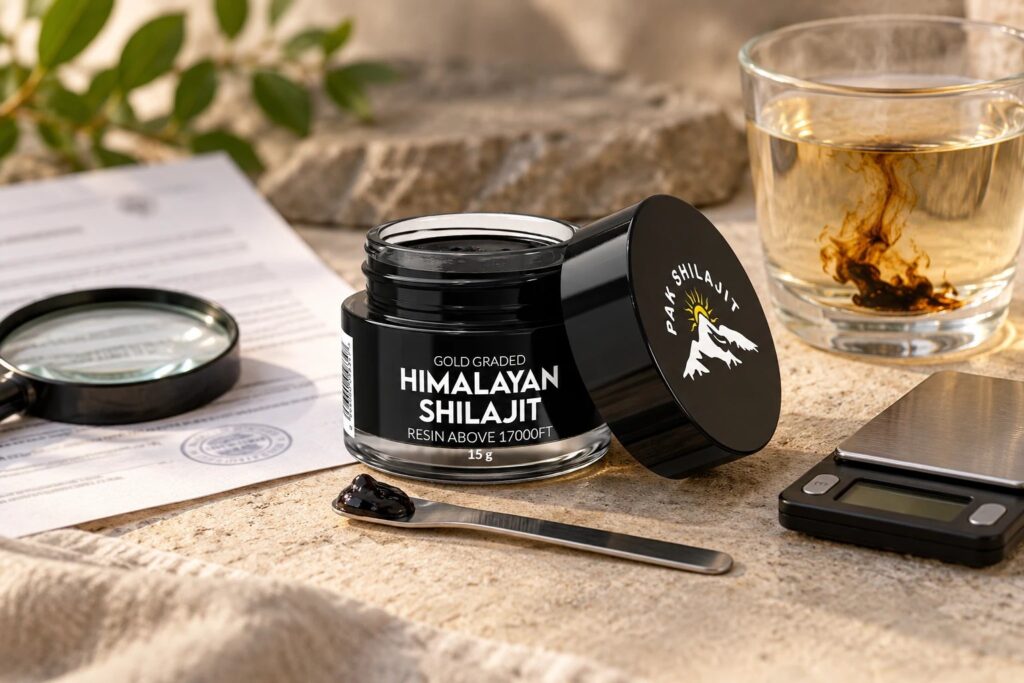
Search “best shilajit” and every answer you get was paid for by someone. The “best shilajit brands of 2025” pages on regional newspaper sites are partner content with affiliate links, the same article republished across five papers with five different dates. The AI summary at the top of the page repeats those pages by name. The biggest marketplace’s best-seller chart puts a ten-ingredient gummy first. The brand blogs pick themselves.
We sell shilajit, so this page will not rank brands either. It does something more useful. It gives you seven checks you can run on any jar in five minutes, and then it runs them on ours, in public, including the one we only half pass.
Why there is no honest “top 10 shilajit brands” list
Here is how those lists get made. A brand pays a media company for a “review” placed on newspaper websites. The page carries a small disclosure that the publisher earns a commission on every purchase made through its links, and sometimes a photo credit that says the winning brand supplied the picture. The same three products win, in the same order, on every site in the chain. None of it is illegal. All of it is advertising.
The AI summary at the top of the results page is assembled from whatever ranks, so it recites the same three names with the same “best overall” labels, minus the disclosure. A best-seller chart ranks by units sold, which measures marketing, not resin. A brand’s own “which shilajit is best” blog recommends the brand. Forum threads are honest and useless in equal measure, because every answer is one person’s jar. And the one independent laboratory comparison that exists sits behind a paywall and covers a handful of products.
What an honest answer looks like is not a list. It is a method: the things a good jar can show you and a bad one cannot. Most of them you can check in the time it takes to read a label. Real talk: if a page will not tell you how to check its recommendation, it is not a recommendation.
Check 1: a lab report you can read, with a lot number
Shilajit is a rock exudate. It comes off the mountain carrying whatever the mountain carried, and heavy metals are the defining risk of the category. Our side effects guide covers the published measurements; the short version is that most tested products sit under the limits and a few batches did not. The only way to know which kind you are holding is a certificate of analysis for that batch.
A real report has five things on it. The laboratory’s name and accreditation on the letterhead. The date. Arsenic, cadmium, lead and mercury, each with a number in milligrams per kilogram, which is the same as parts per million, or “ND”, not detected, below what the instrument can see. A lot or batch identifier that you can match to the jar. And a signature or a report number you could quote back to the lab.
To turn a number into what you swallow, multiply by the serving. A resin reading 0.70 mg/kg of lead carries 0.21 micrograms in a 300 mg serving. For scale, the FDA’s reference level for lead is 2.2 micrograms a day for children and 8.8 for women of childbearing age. The arithmetic is in the side effects guide, and it is the arithmetic every buyer should be able to do from the label and the report.
The lot number is the part most reports skip, ours included on five of seven, and it matters: a report without a batch identifier proves that somebody sent something to a laboratory once. You can see the format on our lab tests page, where every report is listed with its date, laboratory, result and the batch line, which says “not stated on report” where that is the truth.
If a listing shows no report, send one sentence: “Please send the certificate of analysis for this lot.” A brand that has one replies the same day. A brand that replies with a marketing PDF has answered a different question.
Check 2: the fulvic acid number, and why the big numbers are the red flag
Fulvic acid is the component the research treats as the active one (Carrasco-Gallardo 2012), so it is the number worth reading. It is also the number most inflated on labels. “75%+”, “80%+”, “85% fulvic”, “100% fulvic acid” all appear on listings, usually next to “85 trace minerals”, and almost never next to a report.
Two published figures put those claims in context. The processed shilajit used in the research was standardised at 56.75% fulvic acids by weight (Surapaneni 2012). And the literature describes the whole humic fraction of shilajit, fulvic acid plus humic acid together, as around 60 to 80% of the material (Carrasco-Gallardo 2012). A label claiming 80% or more fulvic acid alone is claiming more fulvic than the entire humic fraction usually measures. Either the product is a standardised extract with fulvic acid added, which is a different product and should say so, or the number came from a method nobody has named, or from nowhere.
Our resin measured 71.6% fulvic acid with 9.67% humic acid on the same report, and we print exactly that, not a rounder number, because that is what the instrument read. The report is on the lab page. What you want from any brand is the same thing: one number, one method, one lab, one report you can open. Our guide to natural versus lab-made shilajit explains why a jar that passes every lab test can still be built to the spec rather than dug from a mountain, and what that looks like.
The mineral count is the other half of the same trick. “85 trace minerals” is a count of elements detectable in raw rock exudate, which includes the four you least want. A high count is not a virtue. A heavy-metal panel is.
Check 3: the form, and what its milligrams mean
The word “shilajit” covers five different products. Whole resin, the tar-like paste in a jar. Standardised extract, the powder inside most capsules and tablets, which is what the trials used. Dried powder, which may or may not be either. Gummies, which carry some amount of one of the above. And honey sticks, resin stirred into honey. The milligrams on each label mean different things, and there is no conversion factor between them. Our dosage guide walks through it form by form, with every human trial and its dose in one table.
So the check is not “which form is best”. It is “does the label say what the milligrams are of”. A capsule that says “500 mg shilajit” without saying extract or resin or powder has told you the weight of something. A gummy that lists shilajit at “4000 mg” per serving inside a ten-ingredient stack has told you a marketing number; the trials never went past 1,000 mg a day of extract, and no gummy holds four grams of anything. A honey stick that states 300 to 500 mg of resin per stick has been honest, and our honey sticks guide shows which ones do.
Which form suits you is a fair question with an honest answer. Resin gives you a dose you set yourself, resin you can test in a glass, no sugar, and the lowest cost per milligram; it also tastes of tar and needs a spatula. A capsule is convenient and untestable. A gummy is the one people finish; ours carry 200 mg of the same resin each, honey-sweetened, one a day. Drops are resin in solution for people who want the resin without the spoon. Pick the form you will actually take every day, then run the other six checks on it.
Check 4: source and processing you can actually verify
“Himalayan” is on almost every label, and on most of them it is decoration. The Himalayas run through five countries; “wild-crafted at 16,000 feet” cannot be checked by anyone holding a jar. So weight the things that can be checked over the things that cannot.
A brand that knows where its resin comes from names the country and the region, not a mountain range. It says how the raw exudate was cleaned, because raw shilajit is rock and soil and plant matter and something has to separate the resin out. It says how it was dried, because that is where the category splits: sun-drying takes weeks and keeps the resin whole; heat-drying takes hours and is how most of the market does it. Our page on sun-dried versus heat-treated shilajit covers what the difference does to the resin and what it looks like in the jar. It shows the place, with photographs, because a process you can see is a process you can believe.
Here is ours, as an example of the level of detail to expect from anyone: hand-harvested at 17,000 to 18,000 feet in Pakistan, filtered with Triphala and nano filtration, sun-dried for 45 to 70 days in Abbottabad, by the same people for ten years. The process page has the pictures. If a brand cannot give you that paragraph, it is buying resin from someone who can, and marking it up.
Grade words need the same treatment. “Gold grade” means something specific, and our guide to gold-grade shilajit explains what, and why the word on a label is not the same as the grade in the jar.
Check 5: a stated serving and a stated count
A jar of resin that does not say how much to take is a jar that does not want you to do the maths. The label should state the serving in milligrams, the number of servings in the jar, and give you a way to measure it. Ours says 300 mg once a day, about 50 servings per 15 g jar, and puts a steel spatula in the lid; a pea-sized piece is the serving, and the dosage guide has the photo of what 300 mg looks like beside a grain of rice and a pea.
Be suspicious of “a gram a day”. No human trial used a gram a day of resin; the studied range is 200 to 500 mg a day of extract, with one trial at 1,000 mg. A gram-a-day label empties a 30 g jar in a month, which is good for the brand and pointless for you. The serving decides the cost, which is the next check.
Check 6: price per serving, not price per jar
The jar price tells you almost nothing. The serving size and the count tell you everything. Divide the price by the number of servings, and compare that.
Two jars at the same price and weight can be three times apart on cost per serving if one label says 300 mg and the other says a gram. A cheap jar with a gram-a-day serving is an expensive jar. An expensive jar with a stated 300 mg serving and a lot-numbered report may be the cheaper one per day and the only one you can check.
Prices as read on the day, our list prices on 25 September 2026, arithmetic only, no advice about what anything should cost:
| Product | Price and pack | Stated serving | Servings | Cost per serving |
|---|---|---|---|---|
| Resin jars on the market, typical range | $30 to $110 for 15 to 30 g | “a pea” to “a gram” | 15 to 100 | $0.30 to $4.00 |
| Pak Shilajit resin, 15 g | $54.99 | 300 mg | about 50 | $1.10 |
| Pak Shilajit resin, 30 g | $79.99 | 300 mg | about 100 | $0.80 |
| Pak Shilajit gummies | $44.99 for 30 | 200 mg resin | 30 | $1.50 |
| Pak Shilajit drops, 30 ml | $79.99 | four drops | 100 | $0.80 |
Read it as a method, not a scoreboard. The same arithmetic on any jar takes ten seconds, and it exposes the gram-a-day label faster than any review does.
Check 7: the home tests, and what they can and cannot prove
Real resin behaves in ways a fake cannot copy for long. It dissolves in warm water into a clear, tea-coloured liquid without grit. It softens in a warm hand and stretches rather than crumbling. It goes hard and brittle in the freezer. It smells of tar and smoke, not of chocolate or nothing. Our guide to checking real shilajit runs through six of these with what each one catches and what it misses.
What they cannot do is prove purity. A jar can pass every kitchen test and still carry lead, and a lab-made resin can be built to pass all six. That is why this is check 7 and not check 1: the home tests catch the obvious fakes for free, and the report catches the rest. Do both.
Red flags that end the conversation
Some things on a label are not warning signs. They are the answer.
- “100% fulvic acid”, or any fulvic figure above what the whole humic fraction measures, with no report and no method.
- “85 trace minerals” as the headline, with no heavy-metal panel underneath it.
- No lot number anywhere, on the jar or the report.
- “No side effects.” Every substance has them; the honest brand tells you the known ones.
- Disease words. A supplement label that promises to treat or cure anything is breaking the rules it operates under.
- “Clinically proven” with no trial named. The trials exist and can be cited; a brand that will not cite them is not relying on them.
- A top-10 list with affiliate links as the source of the recommendation.
- A ten-ingredient stack sold as shilajit, with a four-figure milligram claim that no serving could hold.
- A price per gram that is too good. Real resin is hand-collected at altitude and dried for weeks. It has a floor.
None of those needs a brand name attached. If you see one, put the jar back, whoever made it.
Best shilajit for men, for women, for testosterone: it is the same jar
No trial has ever compared brands, and none has compared “men’s” shilajit with any other kind. The human trials used a standardised extract at 200 to 500 mg a day and measured what they measured: testosterone in men aged 45 to 55, strength retained after fatigue in active men, bone density in postmenopausal women, a collagen marker in trained men, sperm parameters in men with low counts. All of it is tabled with doses and PubMed links in the dosage guide.
A product marketed “for men” is the same resin, usually at the same dose, sometimes with herbs added, each of which is its own product with its own cautions. “For testosterone” is one trial, in one age group, at one dose, and the honest sentence is that sentence. For women, the trials that enrolled women and what they measured are on our shilajit for women page. Nobody has measured anything about erections or size, whatever the listing implies, and we will not pretend otherwise.
So the best shilajit for a man, a woman, or anyone hoping for a number to move is the jar that passes the seven checks. The label on the front does not change what is inside.
So which shilajit should you buy? Our jar, through the same seven checks
You came for a recommendation. Here is the only one a brand can make honestly: ours, held to the same checks, with the gaps left in.
- 1. Lab report with a lot number. Seven reports from five laboratories on the lab tests page, the latest a December 2025 heavy-metal panel on the resin: arsenic 0.50, cadmium 0.020, lead 0.70, mercury 0.003 mg/kg. Two of the seven reports carry a batch identifier; the other five do not, and the page says “not stated on report” rather than inventing one. That is the half-pass, and it is written down where you can see it.
- 2. Fulvic number. 71.6% fulvic acid, 9.67% humic acid, one report, one lab, printed in exactly that form everywhere we use it.
- 3. Form and milligrams. Whole sun-dried resin, and the label says so. The gummies state 200 mg of that resin each; the drops state four drops a serving.
- 4. Source and processing. Pakistan, 17,000 to 18,000 feet, Triphala and nano filtration, sun-dried 45 to 70 days in Abbottabad, photographed on the process page.
- 5. Stated serving and count. 300 mg once a day, about 50 servings per 15 g, spatula in the lid.
- 6. Price per serving. $1.10 on the 15 g jar, $0.80 on the 30 g, as read today.
- 7. Home tests. Warm water, hand, freezer, smell. Run them on the resin when it arrives; the guide tells you what to expect.
If you want the resin without the spoon, the gummies carry 200 mg of it each and the drops carry it in solution. Same resin, same reports.
And the sentence that keeps this page honest: run the same seven checks on any other jar, and if it passes them, buy that one. We would rather you bought a good jar from someone else than a bad one from anyone.
Frequently asked questions
The one that can show you a lab report for your batch, states its fulvic acid figure from that report, names its country and process, prints a serving in milligrams, and passes the home tests. No published trial has compared brands, so any page that ranks them is ranking something other than evidence. This guide gives you the seven checks instead of a name.
None, and “100% pure” is not a measurable claim. Purified resin still contains humic and fulvic acids, minerals, trace metals and water. What you can ask for is a heavy-metal panel with the four numbers under the limits, and a fulvic acid figure with a method. A label saying “100% fulvic acid” is a red flag, not a purity statement.
Real resin dissolves clean in warm water, stretches when warm, goes brittle when cold and smells of tar. Those tests catch the obvious fakes for free. They cannot catch a lab-made resin built to pass them, which is why a lot-numbered report and a named source matter more than any kitchen test.
Seven checks: a readable lab report with a lot number, a fulvic acid figure inside the published range with a method, a label that says what its milligrams are of, a named country and process, a stated serving and count, a sane price per serving, and the home tests. A jar that passes all seven is good quality whoever made it.
The one you will take every day. Resin gives you dose control, testability, no sugar and the lowest cost per milligram, at the cost of taste and a spatula. Capsules are convenient and untestable. Gummies are the ones people finish; check the milligrams of resin per gummy. Drops are resin in solution. The trials used standardised extract, so no form has a trial advantage over another.
The human trials are small and short, they used 200 to 500 mg a day of extract, and they measured specific things in specific groups over eight to fourteen weeks. Our dosage guide lists every one with its result. Whether that is worth it to you depends on what you wanted it for, and the honest answer starts with reading what was actually measured rather than what a listing promises.
Trust is a report you can open, not a badge. The most trusted brand is whichever one answers “please send the certificate of analysis for this lot” with the certificate, the same day. Ask, and the answer sorts the market for you.
Any brand whose label carries the red flags above: a fulvic figure above the published range with no report, a mineral count in place of a metal panel, no lot number, “no side effects”, disease claims, “clinically proven” with no trial named, or a milligram figure no serving could hold. The flag is the answer; the name is not needed.
Resin is the whole material, which you can test and dose yourself. Capsules usually hold a standardised extract, which is what the trials used and which you cannot test at home. Gummies hold whatever the label says, so read the label. “Better” depends on whether you value testability and dose control or convenience; the checks in this guide apply to all three.
From whoever passes the seven checks, and preferably from the brand itself, where the lab reports and the process page sit next to the product. Marketplaces rank by sales, not by resin, and third-party resellers can list a real product at any price with any copy. Buying direct means the report on the page matches the jar in the box.
Shilajit is a food supplement, not a medicine. Dietary supplements are not reviewed by the FDA for safety and effectiveness before sale (FDA). It is not intended to diagnose, treat, cure or prevent any disease. If you are pregnant, nursing, taking medication or managing a health condition, speak to a qualified professional first.
Our promise
Zero fillers. Nothing added, nothing taken away. Nature made this over centuries, and our only job is to keep it that way between the mountain and your jar — no heat, no chemicals, no shortcuts.
Your body is built to take minerals from natural sources, not synthetic ones. That's the whole reason we do it the slow way. Your health matters to us more than our production speed does.