
Using shilajit
How Much Shilajit Per Day? Dosage by Form, From the Trials
Read five labels and you get five answers. 300 mg. 500 mg. 1,000 mg. “A pea.” “A gram.” Somewhere on Reddit someone is quoting a traditional text that supposedly says 10 to 40 grams a day. And every article ranking for “how much shilajit per day” gives you a range with no source attached.
Here is the direct answer, with the sources attached. The human trials of shilajit cluster at 200 to 500 mg a day of a standardised extract. One trial went to 1,000 mg a day for eight weeks. The only trial of resin, the form in our jars, used 500 mg a day. Our serving is 300 mg of resin once a day, which is a pea-sized piece, and this page explains why it is that and not a gram.
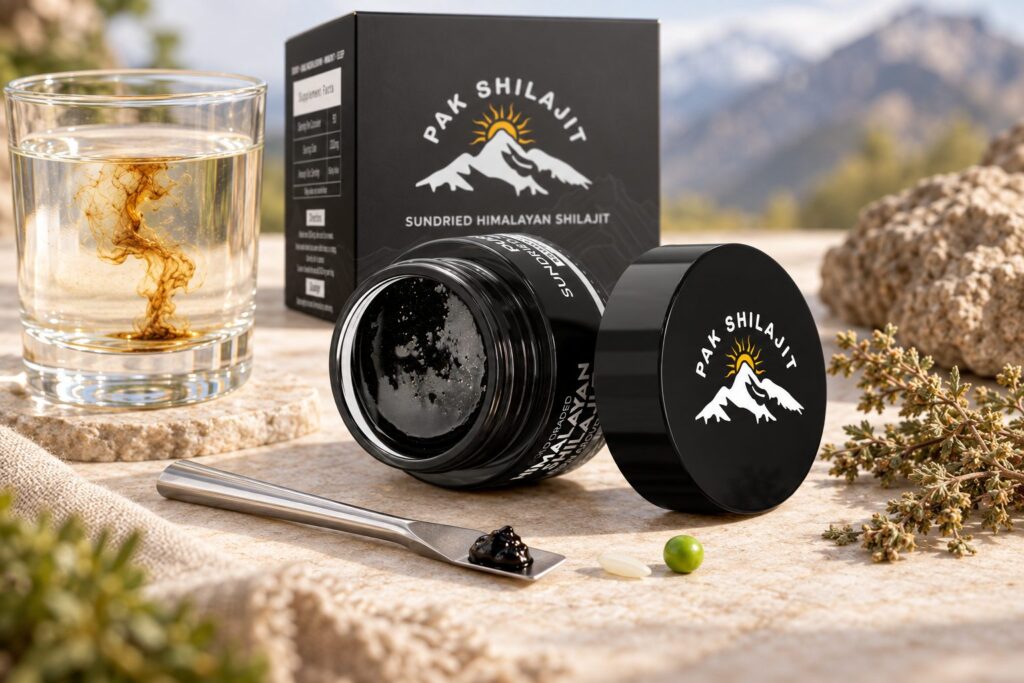
The rest is the evidence, form by form, with a photo of what 300 mg actually looks like on the spatula.
Shilajit dosage at a glance
| Form | A serving | What that is | How many a day | Watch for |
|---|---|---|---|---|
| Resin (ours) | 300 mg | A pea-sized piece on the spatula | One | The scoop is the dose; overdoing it is easy |
| Gummies (ours) | One gummy | 200 mg of real resin plus honey and apple flavour | One | Two is 400 mg, inside the trial range, and no reason to |
| Drops (ours) | Four drops, about 0.3 ml | 80% resin, 20% herbal spring water, measured for you | One | Shake the bottle; count the drops |
| Capsules | Read the label | Dried powder or an extract; the milligrams mean different things | As labelled | “500 mg” of what? |
| Powder | Weigh it | A “pinch” is not a dose | As labelled | Needs a 0.01 g scale |
| Honey sticks | 250 to 500 mg on the labels that state it | Resin stirred into a few grams of honey; some listings state nothing | One | 4 to 8 g of sugar per stick, and a number you cannot test |
What every human trial actually used
There are not many, and they agree with each other more than the labels do. Every one was opened on PubMed for this page.
| Trial | Dose | How long | Who took it |
|---|---|---|---|
| Biswas 2010 | 100 mg processed shilajit, twice a day | 90 days | 35 men with low sperm counts, under a doctor |
| Pandit 2016 | 250 mg purified shilajit, twice a day | 90 days | Healthy men aged 45 to 55 |
| Das 2016 | 250 mg, twice a day | 8 weeks, then 4 more with exercise | Overweight adults |
| Das 2019 | 125 or 250 mg, twice a day | 14 weeks | Healthy women |
| Keller 2019 | 250 or 500 mg, once a day | 8 weeks | 63 recreationally active men |
| Neltner 2024 | 500 or 1,000 mg, once a day | 8 weeks | 35 recreationally trained men |
| Pingali 2022 | 250 or 500 mg a day | 48 weeks | 60 postmenopausal women with low bone density |
| Yadav 2026 | 500 mg of resin a day (250 twice) | 28 days | 25 healthy men |
| Sharma 2003 | 2 grams a day | 45 days | Healthy volunteers |
Three things fall out of that table. The cluster is 200 to 500 mg a day, mostly split into two doses of 125 to 250 mg. The ceiling anyone has tested in a controlled trial is 1,000 mg a day, for eight weeks, in young trained men. And every dose was fixed. Nobody was dosed by body weight, by age, or by goal. A 60 kg woman in the 2019 trial and a 90 kg man in the 2024 trial were given the same kind of number.
Examine’s summary, that trial dosing “has ranged from 200 to 2,000 mg daily” with 500 mg split in two the most common, matches the table; the 2,000 is the one 45-day study at 2 grams.
Milligrams of what? Extract, resin, powder and gummies are not the same
This is the part every label skips, and it is why the numbers online never agree.
A standardised extract is shilajit that has been processed to hit a set fulvic-acid percentage, batch after batch. Most of the trials above used the same branded extract. Their 250 mg is 250 mg of that.
Whole sun-dried resin is the material itself, purified and dried but not standardised. What it contains is what the mountain and the drying gave it. Ours measured 71.6% fulvic acid by the IHSS/AOAC method, and the lab report that says so is downloadable. A label promising 85 or 90 percent is either using a different method or something was added.
Dried powder in a capsule holds less water than resin, so a smaller number of milligrams can stand in for a resin serving. A gummy carries a fixed amount of resin plus everything that makes it a gummy.
So 500 mg of extract, 500 mg of resin, 500 mg of dried powder and a “500 mg” gummy are four different things. There is no conversion factor between them that anyone has measured. A label that says “500 mg” without saying of what has not told you a dose. Ours say resin.
Why our serving is 300 mg and not a gram
Walk the category and you will find “a gram a day” everywhere, sometimes two. Nobody has shown that a gram does more than 300 mg. The trials did not go there, apart from one 45-day study that gave 2 grams a day and measured blood chemistry rather than benefit.
What a bigger scoop reliably does is raise the odds of the mild stuff: loose stools, a headache in week one, a night you cannot sleep. That curve is laid out in our shilajit side effects guide. It is the cost of more, and there is no matching benefit to set against it.
So 300 mg is a choice we made, not a number a trial handed us, and here is the reasoning. It sits inside the window the human trials used. It is a resin serving, so it is not diluted by a filler or a sweetener. It is the same every day, because the spatula makes it easy to repeat. And it makes a 15 g jar last fifty days, which is long enough to find out whether shilajit does anything for you at all. If it does, the answer will not change at 900 mg. If it does not, tripling the dose is an expensive way to find that out.
How to measure 300 mg without a scale
Here is where most guides wave their hands. “A rice grain to a pea” appears on labels everywhere, including ours, and it hides a tenfold gap. A grain of rice weighs about 25 mg. Resin is a little denser than rice, so a rice-grain-sized piece of it is 30 to 40 mg. That is a tenth of a serving.
300 mg of resin is a pea. A proper one, about 8 mm across, rolled between your fingers. On the steel spatula in the lid it sits as a rounded blob covering the tip. The photo at the top of this page is what it looks like beside a grain of rice and a pea, and the difference between the two is the whole lesson.
If you want certainty once, an inexpensive 0.01 g pocket scale settles it in a minute. Put the spatula on, zero it, scoop, and read: 0.30 g. After the first time you will not need the scale again, because your eye has been calibrated.
500 mg, for comparison, is a chickpea. A gram is a hazelnut, and if that is what you have been taking, you now know why the jar keeps running out.
Drops and gummies make the question disappear. Four drops is a serving. One gummy is a serving. That is most of the reason those two formats exist.
Shilajit dosage by goal: what the trials used, not a prescription
Search data says people want a dose for a purpose: for testosterone, for the gym, for women, for fertility. What follows is what each trial actually gave, and what it measured. None of it is a prescription, and none of it promises an outcome.
For everyday energy and general use
The general-adult trial gave 250 mg twice a day for eight weeks, then four more with exercise, to overweight adults, and reported the supplement was well tolerated with no change in blood sugar or lipids (Das 2016). That is the closest thing to an “ordinary person” dose in the literature: 500 mg of extract a day, split.
For testosterone
The trial everyone quotes gave men aged 45 to 55 250 mg of purified shilajit twice a day for 90 days. Total and free testosterone and DHEA-S rose compared with placebo, and the pituitary hormones LH and FSH held steady (Pandit 2016). That is the whole answer to “how much shilajit per day for testosterone”: 250 mg twice a day was the dose in the one trial that measured it, in that age group, on that extract. It says nothing about a 25-year-old, nothing about resin, and nothing about how you will feel.
For training and muscle
Two trials in trained men used the highest doses in the table: 250 or 500 mg a day for eight weeks, where the 500 mg group held onto more strength after a fatiguing protocol (Keller 2019), and 500 or 1,000 mg a day for eight weeks, where both doses raised a blood marker of collagen synthesis (Neltner 2024). Those are markers, not muscle you can see. They are also the only reason anyone can honestly say 1,000 mg a day has been tested at all.
For women
The two women’s trials used 125 or 250 mg twice a day for 14 weeks (Das 2019) and 250 or 500 mg a day for 48 weeks in postmenopausal women with low bone density (Pingali 2022). Same window as the men. Our shilajit for women page covers the rest, including the one hard no, which is pregnancy and breastfeeding.
For fertility
The fertility trial gave 100 mg of processed shilajit twice a day for 90 days to 35 men with low sperm counts, in a clinic, with blood work before and after (Biswas 2010). Note the dose: half of everything else in the table. And note the setting. If fertility is the reason you are reading, that is a conversation with a fertility clinic, not with a jar.
Over 50
Two of the trials were in this group already: the 45-to-55 men and the 45-to-65 women. Same doses, same window. Nothing in the data says older adults need more, and the side-effect logic says start at the serving like everyone else.
Shilajit dosage by body weight
There is no such thing, and it is worth saying plainly. No human trial has ever set a shilajit dose by body weight. Every milligram-per-kilogram figure you will find online traces back to rat studies, where the animals were given hundreds of times a human serving to look for harm. The body-weight tables on supplement sites are made up.
What the trials did was give one fixed dose to everyone, and a 60 kg adult and a 100 kg adult got the same 250 to 500 mg. If anything, the lighter person starts at the serving and holds it a little longer before deciding whether to change anything. That is the entire body-weight rule.
Once or twice a day?
Most of the trials split the dose, morning and evening. A few gave it once. No trial has compared once against twice at the same total, so nobody knows whether splitting matters.
Our serving is once a day, in the morning, because a habit you keep beats a schedule you forget. If you prefer to split it, split the same 300 mg. Do not take the serving twice. The timing question on its own, with food or without, coffee or not, is covered in when to take shilajit.
How much shilajit is too much?
The highest daily dose tested in a controlled trial is 1,000 mg of extract, for eight weeks, in 35 trained young men. The highest anyone has published at all is 2 grams a day for 45 days, in one small older study that found no change in blood pressure, pulse, weight or blood counts. Guidance from one US hospital system quotes up to 2,000 mg a day as generally tolerated (Banner Health). None of those is a target. They are the edge of what has been looked at.
The signs you are past your own dose are ordinary: loose stools, an upset stomach, a headache that arrived with the jar, a night you could not sleep. The fix is to drop back to the serving, not to push through. The side effects guide goes through each one and who should not be taking shilajit at all.
The Reddit claim that a traditional text prescribes 10 to 40 grams a day has no source anyone has produced, and nothing in the trials goes within a hundredfold of it. Do not.
Shilajit dosage by form
The shilajit does not change with the format. What changes is how reliably you measure it and what else comes with it.
Resin. 300 mg once a day, a pea-sized piece, dissolved in warm water or under the tongue. The scoop is the dose, which is the honest problem with resin and the reason for the spatula and the photo above.
Gummies. Ours carry 200 mg of the same sun-dried resin each, sweetened with honey, gluten-free and gelatine-free. One a day is the serving. “How many shilajit gummies a day” has a one-word answer for ours; for anyone else’s, read how much shilajit is in one, and whether it is resin or an extract, before you count.
Drops. Four drops, about 0.3 ml, once a day. Ours are 80% resin and 20% herbal spring water, formulated so that four drops sits alongside the resin serving; a 30 ml bottle is 100 of them. The dropper is marked, so the serving is the same every time.
Capsules. Usually the most reliable dose and the easiest to take, and the easiest to misread. Look for two things: the milligrams, and what they are milligrams of. A capsule of dried powder and a capsule of standardised extract are different things at the same number, and neither is resin.
Powder. Loose powder is the one format that genuinely needs a scale. A “pinch” is not a dose, and a level quarter-teaspoon of fine powder can be anything from 400 mg to well over a gram.
Honey sticks. Not mostly honey after all. The labels that state a dose say 250 to 500 mg of resin per stick, inside the trial window, with 4 to 8 g of honey sugar around it; some listings state nothing. One a day is a full serving. What is in one, brand by brand, is in shilajit honey sticks: how much shilajit is really in one.
Starting, adjusting and cycling
Start at the serving, not above it, and stay there for two weeks before you judge anything. Two weeks is long enough for the taste to stop being news and for any week-one stomach or headache to settle or declare itself. What to expect in that time, and after it, is in how long shilajit takes to work.
Cycling, the habit of taking breaks on a schedule, has no trial behind it either way. Every trial above ran continuously, for four weeks to a year. Take a break whenever you like; nothing suggests you need one, and nothing suggests you should not.
The method, warm water not boiling, what it tastes like, how long a jar lasts, is on how to take shilajit.
Frequently asked questions
The one trial that measured it gave men aged 45 to 55 250 mg of purified shilajit twice a day for 90 days. That is a dose that was studied, in that group, on that extract. It is not a recommendation, and this page makes no promise about what it will do for you.
It is the highest dose tested in a controlled trial: eight weeks, 35 trained young men, no reported problems. It is also more than three times our serving with nothing to show for the difference. Stay at the serving unless you have a specific reason and a professional who agrees.
Daily is how every trial gave it, for four weeks to a year, and how it has always been taken. Consistency matters more than quantity. A serving every day beats a large one twice a week.
Morning for most people. Some find it too stimulating late in the day; no trial has tested timing. The timing guide covers the details.
One of ours, which is 200 mg of resin. Two is 400 mg, inside the trial range and pointless. For other brands, find out how much shilajit one gummy contains before you decide.
Two trials used 125 or 250 mg twice a day and reported effects at those doses, and the resin trial used 500 mg of resin. 250 mg of extract once a day is at the bottom of the studied range; 300 mg of resin is our serving. Enough for what, is the honest question, and the trials cannot answer it for an individual.
It is the smallest dose in the table, used twice a day in a clinic trial of men with low sperm counts. One of our gummies is 200 mg of resin. If 200 mg is what you take, take it every day and give it the full two weeks.
Scoop a pea-sized piece with the spatula. A grain of rice is about 25 mg, ten times too small. If you want to be sure, a 0.01 g pocket scale reads 0.30 g, and after one check your eye knows.
A chickpea. It is the resin trial’s daily amount, taken as two halves. Our serving is smaller than that on purpose.
Either, at the same total. Most trials split it; no trial has compared once against twice. Ours is once, in the morning, because that is the version people keep doing.
None. Shilajit is dosed in milligrams. Our serving is 0.3 g, the trials used 0.2 to 1 g of extract at the very most, and “a gram a day” is a marketing habit, not a finding.
Shilajit is a food supplement, not a medicine. Dietary supplements are not reviewed by the FDA for safety and effectiveness before sale (FDA). It is not intended to diagnose, treat, cure or prevent any disease. If you are pregnant, nursing, taking medication or managing a health condition, speak to a qualified professional first.
Our promise
Zero fillers. Nothing added, nothing taken away. Nature made this over centuries, and our only job is to keep it that way between the mountain and your jar — no heat, no chemicals, no shortcuts.
Your body is built to take minerals from natural sources, not synthetic ones. That's the whole reason we do it the slow way. Your health matters to us more than our production speed does.