
Uncategorized
Shilajit vs Ashwagandha: Differences, and Can You Take Both?
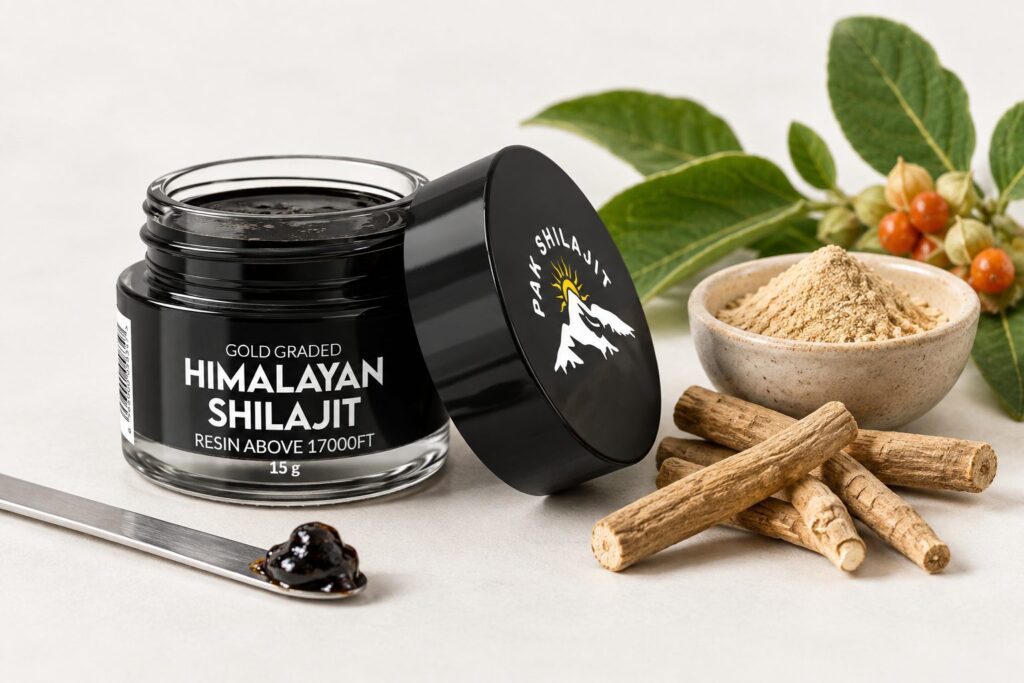
Search „shilajit vs ashwagandha“, or „ashwagandha vs shilajit“, the order makes no difference, and you will find roughly forty articles calling them a dynamic duo, a power couple, or nature’s ultimate stack. Almost none of them mention that these two things are not even the same category of substance.
One is a mineral resin scraped off mountain rock. The other is a root. Comparing them is closer to comparing salt and basil than comparing two rival supplements.
So here is the short version, and then the honest long one. Shilajit is a mineral-rich resin that people take for daily energy and stamina. Ashwagandha is a cultivated herb that people take for stress and sleep, and it has more human trials behind it. Yes, they are commonly taken together. Which one you start with depends on what you are actually trying to change, and the evidence for both is thinner than the headlines suggest.
We sell shilajit. We do not sell ashwagandha. Keep that in mind, and notice that it does not change a single sentence below.
Shilajit vs ashwagandha at a glance
| Shilajit | Ashwagandha | |
|---|---|---|
| What it is | A mineral resin that seeps from rock at high altitude | The root of a plant, Withania somnifera |
| Category | Humic substances, fulvic acid, trace minerals | Adaptogenic herb |
| Where it comes from | Himalayan and Karakoram rock, gathered by hand | Farmed, mostly in India |
| How it is produced | Purified and dried. Nothing is grown. | Grown, harvested, dried, usually powdered or extracted |
| What people take it for | Daily energy, stamina, minerals | Stress, sleep, mood, recovery |
| What the trials looked at | Testosterone and related hormones in one 90-day trial; little else in humans | Stress and anxiety scores, cortisol, strength and recovery, across several small trials |
| Typical serving | 300 mg once daily, dissolved in warm water | Commonly 300 to 600 mg daily, varies by extract |
| How long people usually give it | Four to six weeks before judging | Six to eight weeks, then many people take a break |
| Taste | Bitter, earthy, faintly smoky | Bitter, distinctly horsey |
| Who tends to pick it | People who want something physical and daily | People whose problem is a racing mind or bad sleep |
What each one actually is
This is the distinction that makes every other question easy to answer.
Shilajit is a phytocomplex of humic substances, fulvic acid and trace minerals, formed in mountain rock over a very long time as plant matter breaks down under pressure (Carrasco-Gallardo, Guzmán and Maccioni, 2012, a peer-reviewed review of its composition). Nobody plants it. It is gathered, purified, and dried.
Ashwagandha is a shrub. Its Latin name is Withania somnifera, and „somnifera“ means sleep-inducing, which tells you what people have used it for since long before anyone measured cortisol. The supplement is the dried root, usually concentrated into an extract and standardised to a percentage of compounds called withanolides.
Nothing about those two descriptions suggests they compete. That is the whole point of this article, and every „which is better“ list you have read has skipped it.
Shilajit vs ashwagandha: the five real differences
1. One is a mineral, one is a plant. Everything downstream follows from this. Shilajit’s story is about what is in the rock: fulvic acid and minerals. Ashwagandha’s story is about what a plant makes to survive: withanolides. Different chemistry, different jobs.
2. The research base is a different size. Ashwagandha has a stack of small human trials, several of them randomised and placebo-controlled. Shilajit has a handful, and a 2014 safety review put it plainly: relatively few well-controlled human studies have been conducted (Stohs, 2014). That is not a reason to avoid shilajit. It is a reason to distrust anyone quoting percentages at you.
3. They are dosed differently. Shilajit is a pea-sized amount of resin, about 300 mg, once a day, dissolved in warm water. Ashwagandha is a capsule or powder, and the dose only means something alongside the extract strength on the label, because 300 mg of one extract is not 300 mg of another.
4. What „quality“ means is different. With shilajit, quality is about purity and how the resin was dried: sun-dried resin with a lab report, or heat-treated paste with none. With ashwagandha, quality is about the extract: root only, a declared withanolide percentage, third-party tested.
5. The safety notes are different. Ashwagandha carries specific cautions from the US National Center for Complementary and Integrative Health, including rare reports of liver injury. Shilajit’s risk is almost entirely about the material itself: raw or badly purified resin can carry contaminants that a purified, tested product should not. More on both further down.
Which is better for…
The honest answer changes with the goal, so here it is goal by goal. Where a trial exists, it is named, sized and dated in the same sentence, with its limitation. Where one does not exist, we say so.
Energy and stamina
This is the reason most people reach for shilajit, and it is the reason the traditional literature gives for it. The awkward part: there is no good human trial measuring „energy“ for shilajit. What exists is the mineral and fulvic-acid composition, a long tradition of use, and a lot of people who notice something within a few weeks. That is experience, not evidence, and we label it as such.
Ashwagandha is not usually taken for energy, but stress and poor sleep drain energy, and its trials are about exactly those.
If your goal is physical, daily stamina, shilajit is the one people choose, and we would rather you judged it on a four-to-six-week trial of your own than on a promise from us.
Stress, sleep and mood
This is ashwagandha’s home ground, and it is the one area where the trials are worth reading.
A 60-day randomised, placebo-controlled study of 60 healthy but stressed adults gave 240 mg of a standardised extract once a day and reported lower anxiety scores and lower morning cortisol than placebo (Lopresti et al., 2019). An earlier 60-day trial in 64 adults with chronic stress reported lower stress scores and lower serum cortisol on a full-spectrum root extract (Chandrasekhar et al., 2012). Both are small, both are short, and both used one specific extract, which is why „ashwagandha reduces stress“ is a bigger claim than either paper makes.
Shilajit has nothing comparable here. If a racing mind or bad sleep is the problem, ashwagandha is the one with the trials, and shilajit is the wrong tool.
Testosterone and male hormones
Here the two are closer than the marketing suggests, and the evidence for both is thin.
For shilajit, one randomised, double-blind, placebo-controlled trial gave 250 mg of purified shilajit twice a day for 90 days to healthy men aged 45 to 55 and reported higher total and free testosterone and DHEA-S than placebo, with LH and FSH unchanged (Pandit et al., 2016). One trial, one age band, one manufacturer’s extract. That is the entire human evidence base for the claim you see on ten thousand product pages.
Ashwagandha has trials that measured testosterone as a secondary outcome, and the NCCIH notes it may raise testosterone, which is why the same page tells men with hormone-sensitive prostate cancer to avoid it.
If hormones are your interest, neither has earned a promise. Shilajit has the more direct trial. Ashwagandha has more trials overall. Anyone who tells you one „boosts testosterone by X%“ is quoting a single small study as if it were a fact about you.
Muscle and training
Ashwagandha has the trial. In an 8-week randomised, placebo-controlled study, 57 young men new to resistance training took 300 mg of root extract twice a day alongside a training programme and gained more strength on the bench press and leg extension, and more muscle size, than the placebo group (Wankhede et al., 2015). Beginners, eight weeks, one extract. Real, but narrow.
Shilajit has no training trial of that kind. People take it for stamina through a session; that is a reported experience, not a result.
Women
Both are commonly taken by women, and the questions are different for each. Ashwagandha has specific cautions: the NCCIH says it should be avoided during pregnancy and while breastfeeding, and is not recommended for people with thyroid or autoimmune conditions. Shilajit’s considerations are about purity and iron content rather than hormones. We wrote the shilajit side up properly here: shilajit for women.
Can you take shilajit and ashwagandha together?
Yes. Shilajit and ashwagandha are commonly taken together and there is no widely documented interaction between them at normal serving sizes. They are different kinds of substance doing different jobs, so there is no reason they would compete.
Now the part the „dynamic duo“ articles skip. You will read that they are „synergistic“. We cannot find good evidence for that claim specifically, and we are not going to invent it. Whether the combination is more than the sum of its parts is not something the current evidence answers.
The genuinely useful advice is unglamorous: start one at a time. If you begin both in the same week and something shifts, you have no idea which one to credit. Worse, if something disagrees with you, you have no idea which one to drop. Give one four to six weeks on its own, then add the second.
How to take both, if you take both
| When | How | Notes | |
|---|---|---|---|
| Shilajit | Morning, empty stomach | 300 mg dissolved in warm water | Full detail in when to take shilajit |
| Ashwagandha | Evening, or as the label says | Follow the product’s own dose | Extract strengths vary enormously; a serving from one brand is not a serving from another |
| Both | No need to space them by hours | Convenience is a perfectly good reason to take them at the same time | Some people cycle ashwagandha rather than take it indefinitely |
Stacking a third thing: tongkat ali, sea moss, lion’s mane, moringa
A lot of people searching this page already have a shelf. The honest line for every three-way stack is the same: no trial has tested shilajit and ashwagandha together, let alone with a third ingredient, so nobody, including us, knows how the combination behaves.
That does not make it dangerous. It makes it unstudied. So the rule is the one from above, applied harder: add one thing at a time, wait weeks not days, and read every label for ingredients that overlap. Sea moss is mostly an iodine question, which matters if your thyroid is in play. Tongkat ali and ashwagandha both get sold on hormones, so taking both because a blog said to is a way of doubling a bet you have not checked. Lion’s mane and moringa have no known problem with either, and no known interaction data either way.
Side effects, interactions and who should avoid
This section is deliberately plain. It is the part that matters if you are on any medication.
Ashwagandha. The NCCIH lists drowsiness, stomach upset, diarrhoea and vomiting as reported effects, and notes that although rare, there have been a number of cases linking liver injury to ashwagandha supplements; a 2020 case series described five such cases from Iceland and the US Drug-Induced Liver Injury Network (Björnsson et al., 2020). The NCCIH says it should be avoided in pregnancy and while breastfeeding, is not recommended before surgery or for people with autoimmune or thyroid disorders, and may interact with medicines for diabetes and high blood pressure, immunosuppressants, sedatives, anticonvulsants and thyroid hormone. It also says the evidence for safety covers short-term use, up to about three months. Read the page yourself: NCCIH on ashwagandha.
Shilajit. The risk is the material, not the substance. Raw, unpurified or badly processed resin can carry contaminants, which is why purification and per-batch testing exist. Shilajit is mineral-rich, including iron, so anyone managing an iron condition should ask before taking it. Its stimulating reputation means some people prefer it in the morning. It is not recommended in pregnancy without professional advice, for the simple reason that it has not been studied there.
Both. If you take prescription medication, ask a pharmacist rather than relying on a supplement website, including this one.
How to choose a good one of each
Whichever you take, the same problem applies to both: the supplement aisle is full of material that is not what the label says.
Shilajit. Buy resin, not powder or capsules, and buy from someone who publishes per-batch lab results. Ask how it was dried, because sun-drying and heat-treating produce different products from the same rock (sun-dried vs heat-treated shilajit). The home tests you have seen on video only rule out obvious fakes; they cannot certify a good jar. We set out what actually proves it here: how to check real shilajit. Ours is tested in full, per batch, as issued: read the lab reports.
Ashwagandha. Look for root extract rather than leaf, a declared withanolide percentage, a named standardised extract, third-party testing, and a single-ingredient product rather than a „stress blend“ where the ashwagandha dose is hidden inside a proprietary total. We do not sell it, so that is the whole of our advice.
So which should you take?
- Daily physical stamina, something you take once and forget: shilajit. Give it four to six weeks and judge it yourself. Himalayan shilajit resin.
- A racing mind, poor sleep, feeling wired: ashwagandha. It is the one with trials for exactly that.
- Training and recovery: ashwagandha has the strength trial; shilajit has the stamina reputation. Beginners saw the clearest result in the study above.
- Hormones: neither has earned a promise. Shilajit has the one direct trial; talk to a professional before chasing numbers with either.
- Minerals and fulvic acid: shilajit, because that is what it is.
- Both: shilajit in the morning, ashwagandha in the evening, started at least a month apart.
Shilajit and ashwagandha are food supplements, not medicines. Dietary supplements are not reviewed by the FDA for safety and effectiveness before sale (FDA). Neither is intended to diagnose, treat, cure or prevent any disease. If you are pregnant, nursing, taking medication or managing a health condition, speak to a qualified professional first. This is particularly worth doing with ashwagandha, given the safety notes on the NCCIH page linked above.
Frequently asked questions
Yes. They are different kinds of substance, commonly taken together, with no widely documented interaction at normal serving sizes. Start one at a time so you can tell what each one does for you.
Neither, because they are not the same category. Shilajit is a mineral resin people take for daily energy and minerals; ashwagandha is a root extract with trials for stress and sleep. Pick based on the problem you are trying to solve, not on a ranking.
Shilajit has one placebo-controlled trial in men aged 45 to 55 that reported higher testosterone after 90 days. Ashwagandha has trials that measured testosterone as a secondary result. Both bases are small, so neither justifies a promise.
For stress, nothing on this page. Shilajit is not a stronger ashwagandha; it is a different thing for a different job. If ashwagandha is not doing what you hoped, the answer is usually the extract, the dose or the diagnosis, not a swap to a mineral.
People take it for daily stamina and minerals. The one hormone trial in men reported higher testosterone and DHEA-S after 90 days at 250 mg twice a day. Everything beyond that is tradition and reported experience, not a trial result.
Both are usually taken daily. The NCCIH notes ashwagandha’s safety evidence covers roughly three months of use, which is why many people cycle it. Shilajit is generally taken as an ongoing daily serving. Both should stop the moment they disagree with you.
Ashwagandha, yes; many people prefer it in the evening. Shilajit has a stimulating reputation, so the morning is the usual habit. If either unsettles your stomach, move it to a meal.
There is no interaction data for any three-way stack, so nobody can promise you it is fine. Add one thing at a time, weeks apart, and check overlapping ingredients; sea moss in particular is an iodine question if your thyroid is in play.
Cycling ashwagandha is common practice, and the NCCIH’s short-term safety note is the reason many people do. Shilajit is generally taken continuously. If you are unsure, a pharmacist is a better source than a blog.
Both are commonly taken by women. Ashwagandha carries specific cautions in pregnancy, breastfeeding and thyroid conditions, so read the NCCIH page and speak to a professional. The shilajit side is covered in shilajit for women.
Next, if this was useful
When to take shilajit
Morning, empty stomach, and the two mistakes that cost you.
Shilajit benefits
What it contains, and where the evidence honestly stops.
Shilajit für Frauen
Serving size, safety notes, and the claims we will not make.
Unser Versprechen
Null Füllstoffe. Nichts hinzugefügt, nichts entfernt. Die Natur hat das über Jahrhunderte geschaffen; unsere einzige Aufgabe ist, es zwischen Berg und Glas genau so zu lassen — ohne Hitze, ohne Chemie, ohne Abkürzungen.
Ihr Körper ist darauf ausgelegt, Mineralien aus natürlichen Quellen aufzunehmen, nicht aus synthetischen. Genau deshalb wählen wir den langsamen Weg. Ihre Gesundheit ist uns wichtiger als unser Produktionstempo.