
Using shilajit
How Long Does Shilajit Take to Work? An Honest Answer
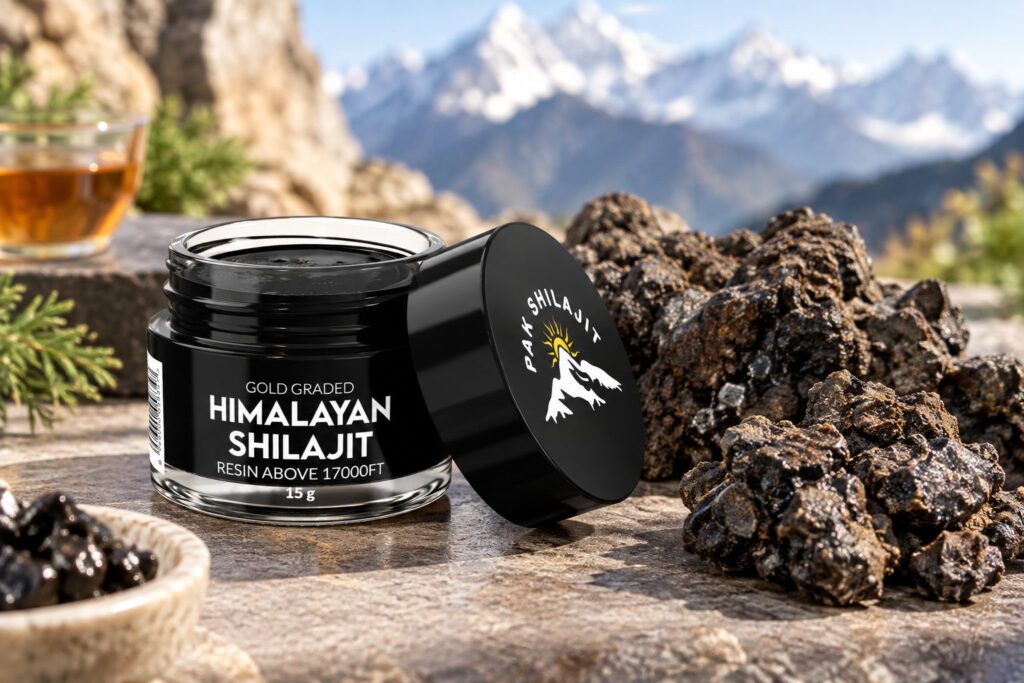
The honest answer: nobody can tell you a date, and anyone who gives you one is guessing. Shilajit is a food supplement, not a medicine, and the way people experience it differs enormously. What we can tell you is what changes, what the traditional pattern looks like, and what is worth watching for — starting with the first week.
Why “it works in seven days” is a sales line, not a fact
Search this question and you will find confident numbers everywhere. Seven days. Two weeks. Thirty days. They are marketing copy, not findings.
Here is the catch. The human research on shilajit is small: a handful of trials, mostly modest in size, often on isolated fulvic acid rather than whole resin. That body of work is not enough to hand anyone a date. A seller who prints one is telling you something about their marketing, not about their material.
So we do not print one. What follows is what people actually report, and what mountain communities have done with this stuff for centuries.
What you will notice on day one
Taste. That is the honest first answer.
Real sun-dried resin is earthy, bitter and faintly smoky. Dissolve a pea-sized portion in warm water and it turns a deep golden brown, never cloudy grey. If what you bought tastes sweet, or of almost nothing at all, the timeline question is the wrong one — you are holding something else. Our guide on how to check real shilajit covers the four proofs that matter before any of this applies.
Week one: the routine settles
The first week is about the habit, not the effect. You find your own way — warm water or milk, morning or evening, the spatula under a hot tap when the resin has set hard. Most people stop measuring by day four.
This sounds unglamorous. It is also the single biggest predictor of whether shilajit does anything for you at all, because a jar in a cupboard does nothing for anybody.
Month one: the honest checkpoint
A 15g jar is about fifty daily servings, so month one is roughly one jar. That makes it a clean point to stop and ask yourself a question no marketing page will ask you: has this become part of your day, or has it become a chore?
Traditionally, shilajit is a natural source of fulvic acid and trace minerals taken to support everyday energy. People who take it consistently tend to describe it in those flat, unremarkable terms — a steadier day, a routine they keep. That is a very different claim from a dramatic switch flipping on a schedule, and it is the one we are willing to put in writing.
Month three: measured in seasons
Shilajit has never been a one-week thing. In the mountain regions it comes from, a small daily serving runs through a season rather than a sprint. By month three you are on your third jar, and you have enough of your own evidence to decide whether it earns a place in your routine.
That is the real timeline: seasons, not days.
Does the format change how fast it works?
Less than the internet suggests. Resin, drops and gummies all come off the same sun-dried line here, so the material is the same material.
What changes is whether you keep taking it:
- Resin is the purest form and the one traditionalists choose — and the one people abandon when the taste or the spoon defeats them.
- Drops solve the spoon problem. Four drops, no warming, and the dropper is marked so the serving is identical every time.
- Gummies solve the “I will forget” problem, which is the most common reason a jar goes unfinished.
The fastest-working shilajit is the one you actually take. That is not a slogan; it is the only honest generalisation available.
What matters far more than the timeline
Purity. If the material is not what it claims to be, no amount of patience helps.
Ask any seller four questions before you ask them how long it takes: where it was harvested, what the raw material looked like, how it was purified, and how long it was dried. We answer all four with dated footage on our process page, and publish the laboratory reports as the labs issued them. A lab report proves a batch is safe; it cannot prove where the material came from, which is exactly why the other four questions exist.
One number worth knowing: heat. Most shilajit is dried fast over fire or in an oven because hours are cheaper than weeks. Ours sits under open mountain sun for 45–70 days. Our comparison of sun-dried versus heat-treated shilajit explains why that is a different product rather than the same product made faster.
Frequently asked questions
There is no honest fixed answer. Traditional use is measured in seasons rather than days, and the research base is too small to support a timeline. What you can judge quickly is whether the material is real — by taste, colour in water, and the seller’s evidence.
The traditional pattern is a small serving daily rather than a large one occasionally. Our serving is 300mg, which is a function of purity: if a product asks for a gram, it is worth asking what is in the other 700mg.
Whichever you will remember. It is traditionally taken first thing, as a morning ritual rather than a pick-me-up, but consistency beats timing.
Then it has not earned its place, and you should say so. Every order is covered by a 30-day money-back guarantee that includes jars you have opened and used — a guarantee that only covers a sealed jar is not really a guarantee about the product.
Yes. Warm water is traditional and makes the colour test easy to see, but it dissolves happily in tea, milk or juice.
Shilajit is a food supplement, not a medicine, and routines differ from person to person. These statements have not been evaluated by the Food and Drug Administration. This product is not intended to diagnose, treat, cure or prevent any disease.
Next, if this was useful
When to take shilajit
Morning, empty stomach, and the two mistakes that cost you.
Shilajit benefits
What it contains, and where the evidence honestly stops.
Shilajit and ashwagandha
Not rivals, and not even the same kind of substance.
Unser Versprechen
Null Füllstoffe. Nichts hinzugefügt, nichts entfernt. Die Natur hat das über Jahrhunderte geschaffen; unsere einzige Aufgabe ist, es zwischen Berg und Glas genau so zu lassen — ohne Hitze, ohne Chemie, ohne Abkürzungen.
Ihr Körper ist darauf ausgelegt, Mineralien aus natürlichen Quellen aufzunehmen, nicht aus synthetischen. Genau deshalb wählen wir den langsamen Weg. Ihre Gesundheit ist uns wichtiger als unser Produktionstempo.