
Shilajit explained
Shilajit Benefits: What It Is, and What Nobody Can Promise You
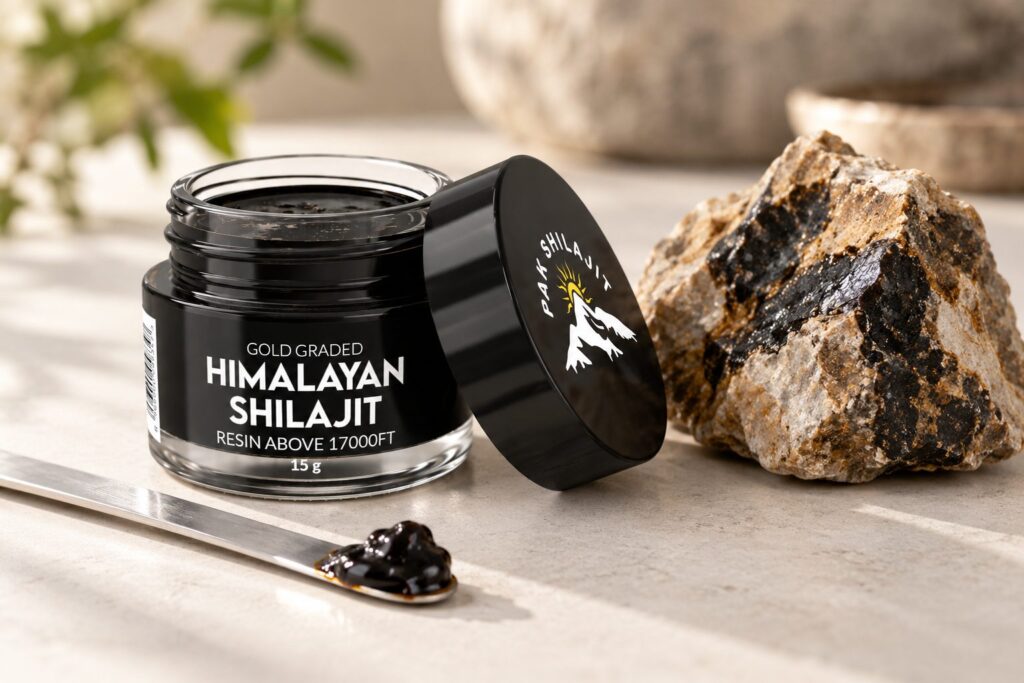
Shilajit is a mineral-rich resin that seeps from Himalayan and Karakoram rock in the summer heat, and it is traditionally taken as a natural source of fulvic acid and trace minerals. That sentence is the whole honest version. Everything past it deserves a careful look, because this is the corner of the internet where supplement marketing goes furthest off the leash.
This guide walks through it in steps: what the material is, what people traditionally take it for, what the evidence base really looks like, and how to judge a jar before you judge the ingredient.
Step 1: understand what you are actually buying
Raw shilajit is not a plant and not an animal product. It is an exudate — stone streaked with dark resin, carried down from high faces in the short summer window when the rock warms enough for it to seep.
What comes off the mountain is not a finished product. It is mixed with the grit it came out with, and it has to be purified before anyone should eat it. Ours goes through Triphala, then ultra UV, then nano filtration — about a week per batch, with two rules holding the whole way through: no heat, ever, and nothing artificial, ever.
Then it dries. Ours sits on open glass beds under mountain sun for 45–70 days, turned by hand.
Step 2: know what is inside it
Two components do most of the talking in the marketing you will read:
- Fulvic acid — the compound most associated with shilajit. Ours tests at 71.6%, from IAS Laboratories in the United States.
- Trace minerals — the reason shilajit is described as mineral-rich in traditional texts.
Here is a number worth pausing on. Our fulvic figure is 71.6%, not the 85% or 90% some labels promise. Real shilajit sits inside a natural range of roughly 50–75%, and a figure above it usually means something was added. We published the real number anyway, and you can read the report as the lab issued it.
Step 3: separate tradition from proof
This is the step most guides skip.
Shilajit has centuries of traditional use behind it, and that history is real and worth respecting. It is not the same thing as clinical evidence. The human research is limited — a small number of modest trials, frequently on isolated fulvic acid rather than whole resin.
So here is the line we hold, and we would rather lose a sale than cross it: shilajit is traditionally taken to support everyday energy, stamina and focus. It is a food supplement, not a medicine, and it makes no medical claims at all. A brand that tells you otherwise is describing a drug it has no right to sell you.
If that sounds less exciting than the page you just came from, that is rather the point.
Step 4: judge the jar, not the ingredient
Almost every argument about whether shilajit “works” is really an argument about whether the shilajit in question was real. Lab-created material passes lab tests perfectly — it was built to the spec. Synthetic fulvic acid can be bought by the kilo and blended into any paste.
So evidence beats adjectives. Ask for four things, in this order:
- Harvesting — which rock face, at what altitude, in which month, and can they show you?
- Raw material — the stone before anything was done to it. Most sellers have never seen their own.
- Filtration — the method, and whether heat was involved at any point.
- Drying — the hardest step to fake, and therefore the most useful question.
Our guide to checking real shilajit goes through each one with the tests you can run at home, and our process page answers all four with dated footage rather than stock mountain photography.
Step 5: pick the format you will actually keep taking
All four formats here come off the same sun-dried line, so the material does not change between them. What changes is the daily ritual — and the ritual is what decides whether a jar gets finished or forgotten.
- Resin: the purest form. Warm water, a pea-sized serving, a taste that reminds you it came off a mountain.
- Drops: 80% resin, 20% herbal spring water. Four drops, no spoon, travels well.
- Gummies: 200mg of real resin, apple flavour, sweetened with honey rather than refined sugar.
Step 6: take it the traditional way
A small serving daily beats a large one occasionally. Ours is 300mg — small because the jar holds gold-grade resin and nothing else.
Most of the category asks you to take a gram. Serving size is a function of purity, so if a product needs a gram, it is worth asking what is in the other 700mg.
Frequently asked questions
Traditionally it is taken as a natural source of fulvic acid and trace minerals, to support everyday energy and general resilience. It is a food supplement, and no honest seller can promise you a medical outcome from it.
Purified shilajit is a food-grade mineral resin, and ours contains nothing but shilajit. The real safety question in this category is not the material, it is what has been added to it — which is why every batch is tested and the report published.
Consult a healthcare professional before use, particularly if you are pregnant, nursing, taking medication or managing a medical condition. Our guide for women covers the questions we are asked most often.
Roughly 50–75% is the natural range. Higher figures are not a better product; they usually mean something was added. Ours is 71.6%, tested and published.
A little. Dissolved in warm water, real resin turns a deep golden brown rather than staying grey or cloudy. It is a useful first check, not a complete one — the full set is in our FAQ.
Shilajit is a food supplement, not a medicine. These statements have not been evaluated by the Food and Drug Administration. This product is not intended to diagnose, treat, cure or prevent any disease.
See the four formats — all sun-dried, all from the same harvest.
Next, if this was useful
How long it takes to work
No honest seller can give you a date. Here is what changes.
When to take shilajit
Morning, empty stomach, and the two mistakes that cost you.
Shilajit and ashwagandha
Not rivals, and not even the same kind of substance.
Unser Versprechen
Null Füllstoffe. Nichts hinzugefügt, nichts entfernt. Die Natur hat das über Jahrhunderte geschaffen; unsere einzige Aufgabe ist, es zwischen Berg und Glas genau so zu lassen — ohne Hitze, ohne Chemie, ohne Abkürzungen.
Ihr Körper ist darauf ausgelegt, Mineralien aus natürlichen Quellen aufzunehmen, nicht aus synthetischen. Genau deshalb wählen wir den langsamen Weg. Ihre Gesundheit ist uns wichtiger als unser Produktionstempo.